by Pinky Jangra | November, 2017 | Pinky Jangra, self-growth
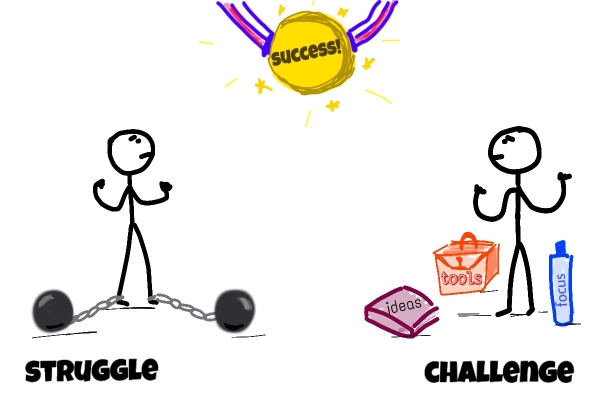
Many of us believe that to achieve something great we have to struggle. Along my entrepreneurial journey I became immersed in this paradigm. Everyone was talking about how hard it is to build a business (or achieve any big dream). I was always hearing stories of immense struggle, grind and ‘no pain no gain’. Many motivational speeches are based on this premise. I started to believe that my struggles were a non-negotiable part of the path I had chosen. I was feeling overwhelmed, confused, exhausted, anxious, insecure and frankly, unhappy. But, apparently everyone feels these things on the path to success. It’s normal and you just have to keep going, right? Wrong. The dangerous misconception In the normalisation and even glamorisation of ‘struggle’, the loose use of this word is risky. It can send people down an unhealthy path. People often aren’t aware of, or at least aren’t articulating the difference between ‘struggle’ and ‘challenge’. These words are used interchangeably but, the difference between them is the difference between a person breaking through or breaking down. Struggle: ‘to make forceful efforts to get free of restraint’ Imagine a ball and chain on your ankle. You struggle for days, maybe even weeks and months trying to get free of it. How does that make you feel? Do you enjoy it? Does it make you inspired and energised, excited and powerful? Or, do you feel desperate, exhausted and powerless? The latter is how I was feeling on my journey. I was in a state of chronic stress caused by the belief that I had to struggle in order to achieve. Stress...
by Pinky Jangra | October, 2017 | Pinky Jangra, self-growth
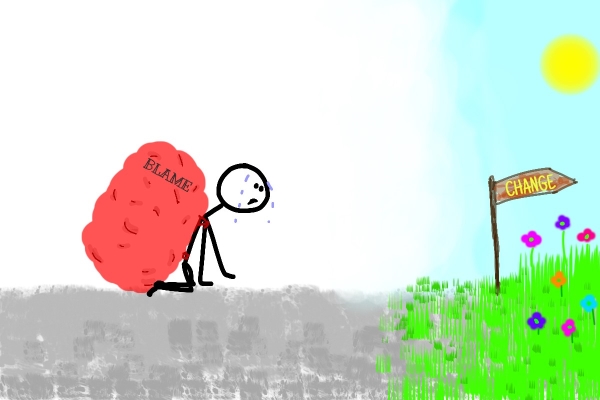
Difficult things happen to us all. Through no fault of our own we and our loved ones can be hurt by people, lose our jobs, experience relationship break ups and so on. Even innocent children may experience severe trauma at the hands of others. Blame is a common human response to such adversity. We blame others and sometimes ourselves too. Blame is often accompanied by emotions such as anger, sadness and hopelessness. There is nothing ‘wrong’ with any of this. I’m not one for avoiding negative emotions. And, I’m not suggesting that people shouldn’t be deemed responsible for their wrong doing (including us). Sometimes, blame is also helpful; a victim of abuse temporarily benefits from blaming the perpetrator in order to release the blame that they’ve often misplaced upon themselves. The problem comes however, when blame lingers for the long term. It can stay for years, decades or even a lifetime, especially when related to deep trauma. Releasing blame associated with very painful experiences can be tough. However, if we are going to progress and make change in our own life, it is absolutely essential. Long term blame takes away your power to change Ask yourself the following questions and answer honestly. Maybe you have a specific blame situation that you can consider when answering, whether it involves blaming yourself or others. Does long term blame make you feel: Empowered and in control of your life? Light, free and unburdened? Happy, grateful and loved? Calm, peaceful and content? Strong, inspired and hopeful about your future? My answer to all of the above, is no. For me, holding onto blame...
by Pinky Jangra | September, 2017 | Pinky Jangra, self-growth
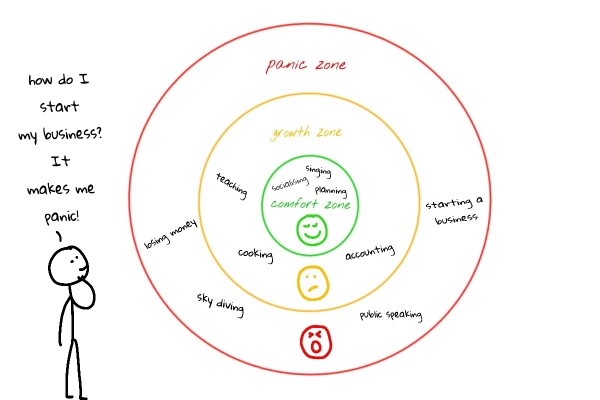
They say the magic happens outside of your comfort zone. I agree. But, it’s a little more complex than this because something else also happens outside of your comfort zone: panic. Panic is a state of terror and uncontrollable anxiety. What would put you in that state? For me, it would be jumping out of an aeroplane because I’m petrified of open heights. Or holding a tarantula. No thank you! Some people overcome their fears by pushing themselves far out of their comfort zone. Even in a state of panic, they’ll jump from that plane. For quick fix, physical experiences this may be appropriate. But this rarely works in daily life What makes us uncomfortable in daily life isn’t often something we can physically push ourselves into for a few minutes and be done with. Instead, we’re likely to experience prolonged, difficult change that requires a more complex response from us. We may choose these changes like starting our own business or ending a relationship. Or, they may be thrust upon us like an unexpected financial problem or being asked to do a difficult piece of work. Any of these things can send us into panic. Panic is not productive There’s a part of our brain that is thoughtful and considered. It creates plans and solutions. It helps us during life’s challenges and facilitates our growth. When we panic, this part of the brain stops working. You’ll notice this when you’re highly stressed. You struggle to speak clearly and you literally can’t think. Someone could ask you your address and you’d need a minute to think about the answer!...
by Pinky Jangra | August, 2017 | Pinky Jangra, self-growth
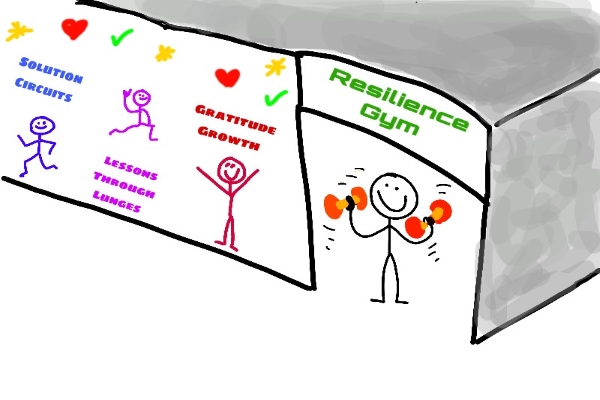
When life goes downhill our natural defence mechanisms usually kick in, that is, our flight, fight or freeze responses. Let’s say your relationship ends, the pain of heartbreak might make you shut down and freeze. What if you got fired from your job? Some people might fight back with anger. If someone’s financial situation starts to crumble, their natural instinct may be to flee, to avoid dealing with it. Each person’s defence mechanisms will be slightly different but, they will usually appear for at least a brief period. Such is the nature of being human, these are our natural warning signs to say that something is going wrong. The problem comes when: A tendency to shut down after a break up turns into a person’s long term reclusive behaviour. Some days they don’t even want to get out of bed. A person’s anger after being fired starts turns into prolonged resentment. The ongoing stress affects their sleep and overall health. The instinct to avoid facing financial struggles means that a person’s debts get greater and greater as they bury their head in the sand. Any of the above could lead to other behaviours such as seeking solace in alcohol, drugs, comfort food and overloading on other hedonistic activity. Rather than helping a person to be resilient, to bounce back from their challenges, the above behaviours simply take a person deeper into them. They keep a person in a spiral of fight, flight or freeze. They keep them in defence mode. Resilience is not about defence, it is about adaptability and growth ‘The human being cannot be in defence mode...

by Pinky Jangra | July, 2017 | Pinky Jangra, self-growth
Intelligence is commonly associated with intellect. With book smarts. With good grades. In fact, that’s almost the only definition of intelligence in mainstream society. But, is this an accurate measure of human intelligence? Are there other types of intelligence that are also critical to our wellbeing and success? There are types of intelligence at work which we can consciously observe and affect, in order to improve our life. Below, I have grouped these into four categories. No category reigns above another, I suggest balance and integration of all four leads to overall health, wellness and fulfilment. Four categories of human intelligence 1. Instinctive Intelligence This is our innate drive to stay alive and reproduce. Our instincts protect us from pain and guide us towards pleasure. This is a very basic intelligence which we all have, but it’s not always balanced and healthy. For example, some people live primarily for immediate pleasures even if they are harmful in the long run. This is evident in addictions to drugs, food, shopping or gambling. Overactive protection instincts are caused by past trauma or by consuming fearful stories in the media. As a result, people are frequently triggered into stress and anxiety. They perceive danger and threat on a daily basis which not only affects their happiness but also their physical health. Optimal functioning of our instinctive intelligence is critical. 2. Intellectual Intelligence We’ve created wonderful things in this world with our intellect. Often, intellectual ability correlates to better paid jobs so that our basic needs and much more can be satisfied. Intellect can give us deep fulfilment, for example, I really love...

by Pinky Jangra | June, 2017 | Nature, Pinky Jangra, self-development
Too long inside concrete walls and around man made things makes me a little stir crazy! A few minutes sat by the river can quickly alleviate this. There’s a powerful, peaceful and grounding energy in nature that seeps into my being. It brings me serenity, gratitude, awe, inspiration, faith and love. And all I have to do is be in it and be quiet. Nature also teaches me much about how to live my life. Which is not surprising – after all, you and I are nature. We have much more in common with the trees than we do with technology. And so, I look towards plants, animals, the weather and even the whole universe to guide me in my life. Here are my top 5 life lessons from nature 1. Balance brings beauty Eco-systems thrive when there is a balance of all species living in symbiosis. Our physical health is maintained by homeostasis – our body’s natural tendency to seek equilibrium within. Thunderstorms help maintain the balance of electrical charges between Earth and the atmosphere. Unstable atoms will give off particles until they become balanced. Everything seeks balance. So, why not me? Too much give and not enough take leaves me depleted. Too much excitement and not enough calm gets draining. We know that indulging in too much unhealthy food doesn’t do much for our physical health and crash diets rarely do what they promise either. Balance in mind and body is what brings true wellbeing. 2. This too shall pass Nothing stays the same. Nothing lasts forever. The leaves on a tree grow and then they fall....