The Wednesday Tea
And if a group of 43 very old women became integrated and useful to their community…?
Often we hear that it is “normal” that old people are alone… that they “do not care about loneliness”… We also hear some old people say that from time to time they do receive a visit… a quick visit.
Loneliness and isolation are often observed at an older age (1). The stereotypes associated with ageing are striking, and the old women are the main victims of these phenomena (2).
Is this irreversible reality?
In this brief reflection we will focus on the importance of close relationships along our lifetime (3).
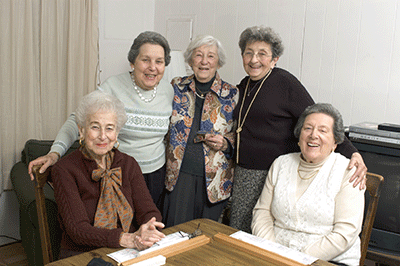
In this article we intend to share the Wednesday Tea (WT) an initiative of the Conference of St. Vincent of Paul. The WT was created to meet the social needs of multi-challenged, although autonomous (living in their homes) older women. These women seemed lonely. WT program aims to fight loneliness while promoting the integration of women in the community. The WT has about 43 very old women, with an average age of 80 years old. The oldest participant is 97. The group gathers weekly every Wednesday, the meetings are ritualized (welcome/ dialogue and activities /pray the rosary and tea time), the admission is free and it can be done at any time during the year. The program has been running for 5 years (since 2010) in Portugal, namely Alentejo, where population ageing and desertification are a serious social problem.
St. Vincent of Paul Conference sees in loneliness a kind of poverty. Some of these women were visited once a week by the Vincentian. These visits used to happen in old women’s home. But 5 years ago the Vincentian began to feel tired – most of them are very old too- and they have realized that the number of elderly they served was increasing. At the same time, older women wanted to have more company and to socialize more. Thus arises the idea of a weekly meeting. The women were challenged to participate and to invite other women in the community.
The program includes nine specific areas of Positive Psychology: 1-Gratitude, 2-Hope, 3 – Constructive Active Listening 4 – Positive Humor, 5-Spirituality, 6-Positive Reinforcement, 7-Flow, 8- Close Relationships 9- Positive Emotions. (4)
Getting out of a feeling loneliness state to feel integrated in a group, women began not only to have conversations of interest – their interest – they have also decided to work when they meet. The tasks are meaningful and chosen by the participants, which has facilitated their connection with the community that appreciates their work. Women often take work home to continue until next Wednesday. The sharing, the identification with others, the sense of belonging to the group and the community, the new friendships, the resumption of old friendships and deepening of relationships contributes to the well-being of these women. (5) At the same time, the group reveals to have a positive impact on the community (6).
Initiatives like this help to age positively while recalling younger generations that older people share the same present and therefore also have dreams and future.
Bibliografia
1 – Fernandes, A. A., & Botelho, M. A. (20007). Envelhecimento ativo, envelhecer saudável: O grande desafio. Sociológico, 17, 11-16.
2- Gergen, M. M., & Gergen, K. J. (2006). Positive aging: Reconstructing the life course. In J. Worell, & C. D. Goodheart (Eds.), Handbook of girls’ and women’s psychological health (416-426). Oxford: University Press.
3 – Vaillant, G. E. (2003). Aging well. New York, NY: Little Brown.
4 e 5 – d’Araújo, M.A., Alpuim, M., Rivero, C., & Marujo, H.A. (2015) Possibilidades para envelhecer positivamente: Um estudo de caso com base na psicologia positiva. Revista E-Psi, 5(1), 40-75.
6 – d’Araújo, M. A. (2015). Avaliação de um programa de intervenção comunitária junto de um grupo de mulheres idosas no interior sul de Portugal (Dissertação de mestrado não publicada). Instituto Superior de Ciências Sociais e Políticas da Universidade de Lisboa: Lisboa. http://hdl.handle.net/10400.5/8013
‘We Are The Positive Psychology People’
O Chá das Quartas
E se um grupo de mulheres muito idosas não só se integrasse mas também contribuísse para a sua comunidade?
É frequente ouvirmos dizer que é “normal” que os idosos estejam sozinhos…que “não se importam”…É também frequente ouvir alguns idosos dizerem que de vez em quando recebem uma visita…rápida.
A solidão e o isolamento são frequentemente sentidos em idades muito avançadas (1). Nestas idades, os estereótipos associados ao envelhecimento são também muito marcantes, sendo as mulheres velhas as maiores vítimas destes fenómenos (2).
Será esta realidade irreversível?
Nesta breve reflexão vamos focar-nos na importância das relações de proximidade ao longo da vida (3).
Neste texto partilhamos O Chá das Quartas (CQ) uma iniciativa da Conferência de S. Vicente de Paulo que surgiu para dar resposta a mulheres velhas, multidesafiadas, autónomas e a residir nas suas casas. Estas mulheres aparentavam solidão. O CQ pretende combater a solidão e ao mesmo tempo promover a integração das mulheres na comunidade. O CQ conta atualmente com cerca de 43 mulheres com uma média de idade de 80 anos, sendo que a participante mais velha tem 97 anos. Os encontros são semanais – quarta feira – são ritualizados (acolhimento/dialogo e/ou atividades/terço e chá), a entrada é livre e pode ocorrer em qualquer momento. O programa decorre há 5 anos (desde 2010) no interior de Portugal, onde o envelhecimento da população e a desertificação são um problema.
A Conferência de S. Vicente de Paulo vê na solidão uma forma de pobreza, algumas destas mulheres eram visitadas uma vez por semana pelas vicentinas. Estas visitas realizavam-se na casa das idosas. Mas, há 5 anos as vicentinas começaram a sentir-se cansadas – a maioria delas é muito idosa – e a ver que o número de idosas a precisar e a desejar a visita era cada vez maior. Ao mesmo tempo, as idosas desejavam mais companhia e convívio. Surge assim e de forma orgânica a ideia de um encontro semanal. As mulheres foram desafiadas a participar e a convidar outras mulheres da comunidade.
O programa integra 9 áreas específicas da Psicologia Positiva: 1-Gratidão, 2-Esperança, 3-Escuta Ativa Construtiva, 4-Humor positivo, 5-Espiritualidade, 6-Reforço Positivo, 7-Flow, 8-Relações de Proximidade e 9-Emoções Positivas. (4)
Saindo de uma situação de solidão e sentindo-se integradas num grupo, as mulheres começaram não só a ter conversas de interesse – do seu interesse – como começaram a querer fazer trabalhos em conjunto. As tarefas realizadas têm sentido e são escolhidas pelas participantes, o que facilitou a sua ligação à comunidade que vê nos trabalhos das idosas algo de interessante. Muitas vezes as mulheres levam trabalhos para adiantar em casa que continuam na Quarta-feira seguinte. A partilha, a identificação com os pares o sentimento de pertença ao grupo e à comunidade, as novas amizades, o reatar de amizades antigas e o aprofundar dos relacionamentos contribui para o bem estar destas mulheres. (5) Simultaneamente, o grupo revela ter um impacto positivo na comunidade (6).
Iniciativas como esta ajudam a envelhecer positivamente ao mesmo tempo que recordam às diferentes gerações que os idosos partilham o mesmo presente e por isso também têm sonhos e futuro.
Bibliografia
1 – Fernandes, A. A., & Botelho, M. A. (20007). Envelhecimento ativo, envelhecer saudável: O grande desafio. Sociológico, 17, 11-16.
2- Gergen, M. M., & Gergen, K. J. (2006). Positive aging: Reconstructing the life course. In J. Worell, & C. D. Goodheart (Eds.), Handbook of girls’ and women’s psychological health (416-426). Oxford: University Press.
3 – Vaillant, G. E. (2003). Aging well. New York, NY: Little Brown.
4 e 5 – d’Araújo, M.A., Alpuim, M., Rivero, C., & Marujo, H.A. (2015) Possibilidades para envelhecer positivamente: Um estudo de caso com base na psicologia positiva. Revista E-Psi, 5(1), 40-75.
6 – d’Araújo, M. A. (2015). Avaliação de um programa de intervenção comunitária junto de um grupo de mulheres idosas no interior sul de Portugal (Dissertação de mestrado não publicada). Instituto Superior de Ciências Sociais e Políticas da Universidade de Lisboa: Lisboa. http://hdl.handle.net/10400.5/8013
‘We Are The Positive Psychology People’
Great that you have provided both English and Portuguese versions Xana. Do you think that people wrinkle on the outside whilst staying essentially the same on the inside? I like Ellen Langer’s observation that there is no biological or scientific way of measuring age, just our birth certificate and the information we provide. Maybe we should be more interested in asking the questions ‘how old do you feel?’ rather than ‘how old are you?’
Hello Lesley. Thank you so much for you kind words.
Yes, I also agree that the most important thing is to remember ourselves that every single person matters independently of the biological age. We are all people…and people feel…and people love. In my experience with those old women, they do not worry very much about their biological age. I mean, most of them them are proud for their age.
I like very much this way of presenting the post
Ellen Jones, thank you so much for you kind words
Adorei! Loved it!