
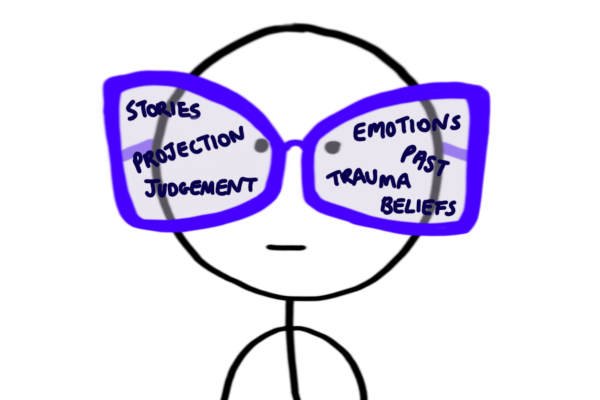
Allow me to take you by the hand and pull you back from the world and introduce you to the art of observation. Let’s retreat a little. Now, from afar, let’s look at what’s going on. Can you see it? The chaos? The confusion? The noise? The fear? Also, the hive of activity, the pace, the constant change. There’s also joy, love, progress and creativity all over the place. Perhaps you can also observe from afar, nature taking its course. The trees in the wind, the birds flying, the ocean roaring and crashing against the shore. What about looking up? At the stars, the sky, the clouds, the moon. And, what about the people and situations in your personal life, what if you just stand back and observe them, too?
How does it make you feel?
Does the difficult stuff make you fearful, anxious and angry to observe? Does it make you want to leap in and fix things or run away and hide? What about the peaceful natural scenes, do they bring you joy and pleasantness, do you want to immerse yourself in them?
Is there also a point at which you can observe all of it and just… see it, impartially? Can you see it without wanting to be in it, without getting dragged into it or being emotionally riled by it? Just see it as ‘information’? Can you stop judging it as good, bad, right or wrong? It just is?
Try this. Practise it. Stand in calm, stillness and just observe. Don’t judge, don’t try to fix, don’t fight or feel, don’t run towards or run away. Just stop and watch.
This is the art of observation
To see life for what it is, pure and simple. No judgement, no projections, no engagement or emotional entanglement, it just is what it is.
This isn’t a state of being that you stay in continuously, ceasing to feel or engage in life at all. That’s probably impossible anyway. And it’s not a state of being that I think is easy to attain. But it is possible and it is a worthwhile practise. It can bring a lot of peace and clarity to your life.
Most of us observe through our emotions
Humans are emotional, that’s just a fact. But, when you are in a highly emotional state, whether ‘good’ or ‘bad’, you are observing through your emotions and they cloud your view.
Have you ever felt worried that someone was doing something wrong – maybe you were convinced they were cheating on you. In this pain and fear, you started making stories and meanings about how they don’t love you, how you’re not good enough, how you must get revenge. And then later, you found out they weren’t cheating at all.
Or, have you failed at one thing and felt so low that it made you perceive your whole life as a failure? Every way you looked you could only see yourself in a negative light, how you look, your lifestyle, your personality – it all starts to look like a wreck. You may have achieved a million great things, but you just couldn’t see it in that moment of pain.
This is how emotions skew our view. When we see through our emotions we are not living in reality. We’re in our heads, observing what we believe is reality, but is in fact, an illusion.
What about positive emotions? They must be good, right? Think again.
When in a state of elation and high pleasure, you also miss reality! This time, reality is obscured by your rose-tinted glasses which filter out the ugly bits.
You know that honeymoon phase of a relationship where we only see the good stuff in the other person? That’s us getting high on our own emotions and missing the downsides which we then get surprised and sad about when they creep in later! But they didn’t creep in, they were there, we just missed them because we were seeing through the veil of highly positive emotion.
Seeing from an elevated emotion might seem preferable because it feels better, but you’re still not seeing objective reality. And that’s what the art of observation is about. Objectivity. Seeing reality, exactly as it is.
See what you see, and then let it be
Objective reality is usually a simple and straightforward truth. In objective reality, you can see what you can see, right here and now, and that’s all.
Your partner is out late every night – that’s objective reality.
Your project failed – objective reality.
You ran out of money – objective reality.
You don’t have all the answers – that’s also an objective reality.
It’s raining – that’s an objective reality.
You need not go further and make up stories about these objective realities, about what they mean about you, your life, other people or the world – which is what emotional entanglement makes you do.
When observing objective reality, you see what is. And then you can decide what to do with it. Seeing the world in this way really simplifies life. You may decide to talk to your partner, restart that project, take a new job, admit you don’t know something or, put your umbrella up in the rain. It’s quite simple. Most things in life do not have to be any more complex than this. It’s only your emotions, stories, illusions and delusions that make things overly complex and painful.
The art of observation helps us to be more calm, functional and effective in life
I am by no means a Buddhist monk or enlightened being – I fail at the art of observation every day! But, I keep practising. It helps me stay grounded and take useful actions based in the real world, rather than the illusory world in my head. I’m also learning to stop taking things personally because I don’t create meanings and stories about everything that happens to me. It just is. It’s just life.
The art of observation clears out a lot of noise, internally and externally. It creates a lot of space and frees up your energy. That space and energy can then be used in much more productive ways. I am making it one of my intentions for 2022 to practise the art of observation. I hope you will too.
Read more about Pinky Jangra and her other articles HERE
Today afternoon, we walked along the Galle Road from Katubedda to Moratuwa and watched the busy city around us. The road was full of movement with most buses, three wheelers. And also people going in and out of shops.I could hear the sounds of traffic and people talking. Some people were waiting at bus stops, and trees gave shade to those walking.Near the Katubadda junction area was very stinks,it feel uncomfortable for me.
Our little observation started around two o’clock, immediately following a heavy rain, leaving the surroundings thoroughly wet with water puddles everywhere. Although this segment of the Galle Road is usually notorious for its rush hour congestion, it felt unusually light, the recent downpour likely served as a temporary deterrent to crowds and vehicles. The people we encountered were a fascinating collection. some displayed visible tiredness, while others notably couples appeared genuinely happy (well at least most of them). Intriguingly, most people’s eyes were fixed on the sky, a clear signal of their underlying anxiety about the rain returning. For the Galle Road, traffic was remarkably subdued, yet the buses moved with startling speed a possible consequence of fewer passengers enabling swift transit. The route itself was a non stop commercial strip, a mosaic of commerce where every kind of shop from vehicle dealerships to liquor stores lined the pavement. Nature offered a contrasting static element a series of trees planted along the median which I observed as a future buffer against the heat on a sunny day. Finally, the uncontrolled pedestrian crossings felt like death traps. The rapid speed of some vehicles, unmoderated by traffic lights created a precarious hazard for anyone attempting to cross.
When I observed Molpe Road from the University to Rawathawatta Junction, I noticed that it is a very busy and crowded area. There are many vehicles such as buses, three-wheelers, and motorbikes moving along the narrow road, which often causes traffic congestion. The noise and rush made the place feel a bit stressful and unpleasant. I also saw water flowing along the side of the road, which made it look untidy and uncomfortable to walk. However, there are also calm places nearby, like temples and a church, which bring a peaceful feeling. Overall, Molpe Road shows both the busy life of the town and a few quiet corners where people can find peace.
I walked from the University of Moratuwa to Rawathawatta Junction while observing the environment along the road. First, I walked along Molpe Road, where there were many boarding places, small shops, and houses. Although it was a slightly busy area, there was a Buddhist temple, and inside the temple, it was very calm. Then I walked along the main road to Rawathawatta Junction. The road was very narrow, and some parts were broken. Because the afternoon was rainy, the road was muddy. There were also many furniture shops and wood companies. It felt like this is the true character of the Moratuwa area. I also noticed several religious places such as churches, Buddhist statues, and temples. Since the environment was filled with the noise of vehicles, I was not able to hear the sound of birds. However, observing this area gave me a valuable experience of practicing the art of observation.
Piliyandala Town
2025.10.24
14:45 p.m.
The town looked like a busy town. Beggars and other people were in the town. There was a four-way junction with traffic lights, traffic jam nearby and people were not allowed to go even on both sides of the road. The Piliyandala clock tower was nearby and were buses, cars, vans, three-wheelers, motorcycles and vehicle parks. There was a park near the school where school children, school buses were parked. And also, there was a playground and a children’s park nearby. Both sides of the road, there was a commercial belt. There were garbage dumps on the main road, but the garbage dumping on the side roads was irregular. Various places of providing various services were located in the town for people’s daily life. There was a reclaimed swamp-like area near the bus stand. I saw very few houses, almost none. Animals like crows, dogs, and cows were seen.
Piliyandala bus stand
2025.10.24
15:05 p.m.
Space was allocated for buses, using nameplates to identify the buses that were going to each area. There were many people because it was evening. Students finishing school, preschool, people finishing work, beggars, taxi drivers could be seen here. There was a threewheel taxi at the junction near the bus stand. And also, there were a few shops, small dustbins, benches to sit on and a tap for drinking water at the bus stand itself. People were tired. The area in front of the bus stand was green with trees. Pigeons, crows and dogs could be seen.
Walking around Piliyandala bus stand and town helped me see both the busy and quiet sides of life. It taught me to stay calm, be patient, and appreciate everyday moments without judging them.
When I walked along the 255 route from Katubedda to Piliyandala, I could clearly see how the environment changes from urban to suburban areas. At the beginning near Katubedda, the area is busy with shops, buses, and people, especially around the university and main road. There are many commercial buildings and services, but also a lot of traffic and noise. As I moved further, the roadside was lined with small shops, food stalls, and houses mixed together, showing how commercial and residential uses overlap. I noticed that some parts had proper sidewalks, but in other places, pedestrians had to walk very close to the road. There were also many three-wheelers and vendors, which made the area lively but a bit congested. When I reached Piliyandala, the surroundings became calmer and more residential with more greenery. Overall, it was interesting to observe how the character of the area gradually changed along this route.
One key observation I made is that there was no proper drainage maintenance system at the Katubedda junction. The drains were overflowing, causing unpleasant odors to spread throughout the surrounding area.
This afternoon, from around 2.00 to 4.30, We walked along the Piliyandala By-pass Road to observe our surroundings. I noticed a lot of wetlands beside the road. Since these days are rainy, the water levels were high And also I could even see some fishes and other small water species.
There were several small vendor shops along the road selling vegetables, fruits, fish, and sweets. I also saw some barbecue stalls and even a temple nearby. Many birds could be seen around the wetland areas, flying and resting on the trees. The road was not too busy at that time, but there were still many vehicles passing by. I also noticed a few tourists who had stopped their vehicles to buy fruits and vegetables from the roadside stalls.
Overall, it was a peaceful and interesting observation. I could see the connection between nature, people, and everyday life along the Piliyandala By-pass Road.
Our observation area extended from Katubedda Junction to Moratuwa. Since it wasn’t peak hour, we were not able to observe much human interaction; however, we did notice some interesting aspects. Even though it was not a busy time, the road was filled with vehicles such as buses, three-wheelers, and lorries. There were a few people at the bus stop, most of whom were schoolchildren.
We also observed an elderly home near Moratuwa, where most of the residents were sitting on the porch dressed in white, reading newspapers. Additionally, we noticed that most of the shops located along the main road were relatively large, while near Katubedda Junction, there were several smaller shops. Along the main road, we saw only a few houses, and some of them appeared to be abandoned.
Our field observation took place from Katubedda to Ratmalana. I noticed several peculiar things that we usually fail to see in our daily rush. There was a tiny plant growing between two blocks on the road, and a bee was gently sucking nectar from it. A nearby house had a balcony filled with colorful plants that enhanced its beauty. I also saw a lady suffering from elephantiasis, begging for money and I could deeply feel her pain. Few cleaners were putting their efforts to clean the road.
Later, we went to a shop to buy ice cream. One of the packages was slightly open, yet the ice cream had not melted because it was kept in the refrigerator.
This observation made me pause, look around, and truly appreciate the world around me. I learned the importance of slowing down and finding meaning in small, everyday moments.